Croatia’s Blue Economy
20.05.2026
Opatija, 20 May 2026 – Privredna banka Zagreb (PBZ), part of the Intesa Sanpaolo Group, in cooperation with SRM, today presented a comprehensive report on the strategic role of Croatia’s Blue Economy in the global competitive landscape. The presentation was followed by a high-level panel discussion gathering leading representatives of the maritime and logistics sectors.
The event was opened by Dinko Lucić, President of the Management Board of Privredna banka Zagreb, who highlighted the importance of the Blue Economy as a long-term growth driver and a strategic pillar of Croatia’s sustainable development.
An institutional keynote address was delivered by Žarko Tušek, State Secretary in the Ministry of the Sea, Transport and Infrastructure who addressed national priorities in maritime transport, port infrastructure and connectivity.
The strategic presentation of the report, titled “Croatia’s Blue Economy. Ports and Shipping as key drivers of growth”, was delivered by Massimo Deandreis, General Manager of SRM - Economic Research Center (Intesa Sanpaolo Group). The presentation provided insights into Croatia’s maritime ecosystem, global logistics trends, port competitiveness and the country’s role within evolving international supply chains.
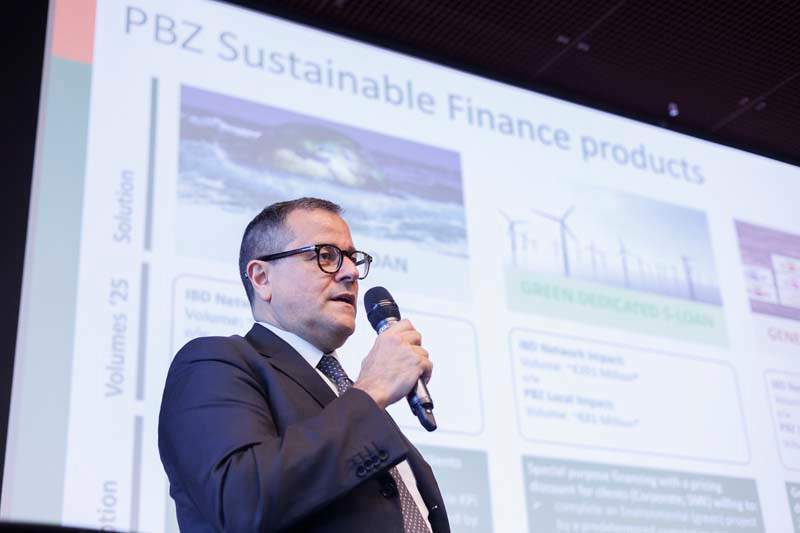
The event continued with a presentation of PBZ’s value proposition for the maritime and logistics sector, delivered by Paolo Musso, Advisor to the President of the Management Board of PBZ and the Candidate for a Member of the Management Board responsible for the Corporate, SME and SB Division who outlined the Bank’s role as a long-term financial partner supporting infrastructure development, digital transformation and the green transition across the Croatian Blue Economy.
The report highlights several strategic messages shaping the future of Croatia’s Blue Economy:
• Croatia is a natural strategic gateway between the Mediterranean and Central and Eastern Europe
Thanks to its location on the Adriatic, it offers direct and potentially more efficient access to EU and Balkan markets. This makes it an increasingly important entry point in Europe’s evolving logistics chains.
• The Blue Economy plays a key role for the country
Croatia ranks first in Europe in terms of the Blue Economy’s share of gross value added in the national economy, accounting for over 7% (€4.1 billion) of the total. The sector provides employment for over 150,000 people.
• The Croatian maritime network is increasingly focused on commercial trade and international logistics chains
Ports are handling growing flows of goods and are progressively integrating with global markets, with foreign trade worth over €66 billion (approximately a quarter of the eastern Adriatic region) and key partners such as China and the USA, thereby strengthening the country’s commercial role.
• Maritime traffic shows stable growth and a progressive qualitative upgrade
Maritime trade is growing at a steady pace (around 3% annually) and the unit value of goods is increasing, signaling a shift towards higher value-added traffic and growing integration into international supply chains.
• Digitalization and sustainability are key drivers for strengthening the competi-tiveness of the maritime system
The adoption of smart ports, IoT and digital technologies, alongside investments in the green transition, aims to improve efficiency, traceability and logistics integration, bringing Croatia into line with the most advanced European standards.
• Croatian ports, with Rijeka at the forefront, represent a developing hub within the Adriatic system
Investments such as the Rijeka Gateway (a new container terminal) and integration into the TEN-T corridors strengthen Croatia’s role as a logistics hub for container traffic and intermodal connections to the European hinterland (with investments in rail transport of around €2.5 billion).
• Croatia is positioning itself as an emerging platform in the Mediterranean for traf-fic to Central and Eastern Europe
Against a backdrop of global route reorganization, the country can capture new flows and develop a role that complements the major hubs, capitalizing on its geographical position and growing infrastructure.
PBZ as a strategic financial partner for the maritime and logistics sector
PBZ supports the development of the Blue Economy through tailored financing solutions, advisory services and international expertise. Leveraging the strength of the Intesa Sanpaolo Group and SRM’s analytical capabilities, PBZ acts as a long term financial partner for ports, shipping companies and logistics operators, supporting growth, infrastructure development, digital transformation and the green transition. Blue economy is viewed as a key component of Croatia’s long-term development, particularly given the importance of tourism and maritime activities to the national economy.
The report presentation was followed by a moderated panel discussion titled “Navigating the Future of the Adriatic”, which addressed global trade realignments, investment priorities in port and logistics infrastructure, and supply chain resilience as key factors in strengthening the long-term competitiveness of the Adriatic region. The discussion featured contributions from Robert Blažinović, President of the Management Board, Jadrolinija; Anton Barbir Member of the Management Board, CFO, ENNA Group; Marko Mišković, Member of the Management Board, Port of Rijeka and Marin Škufca, Chief Executive Director, Liburnia Maritime Agency.
PBZ thanks all speakers and participants for their valuable contributions and looks forward to continued cooperation in developing concrete solutions that support the Croatia’s Blue Economy and a sustainable future of the country.